Sunday, July 19, 2009

Recycling Clutter


Resolute
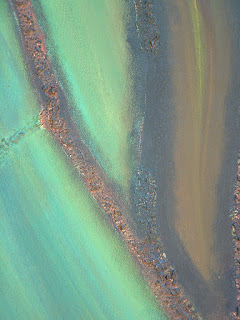
acrylic on paper
9" x 12"


I've not been creating as much as I’ve been destroying! After cleaning up my desk at work, de-cluttering has continued at home.

Isn’t it amazing how much stuff we accumulate? For a reader, it is magazines and books, for the mixed-media artist it is interesting items, for the archivist it is newspaper or magazine articles. Since I am a little of all the above, I am amazed at things I’ve hung on to for years.

Do any of you remember old scrapbooks? Those large books from the dime store with dull gray or brown paper, held together with either screw posts or heavy thread? You could get refills and make very thick books. They were pretty ugly specimens. Unfortunately, it was long before the current scrapbooking craze introduced acid-free materials.


I still have some of these dinosaurs, including my first one started 40 years ago celebrating the historic 1969 moon landing. I continued the format, making other scrapbooks—current events, favorite television shows, the space program, etc.


Being in that saving and preserving mentality, I continued clipping interesting articles. But as I got older and busier, I never put them into anything but large folders.

Other forgotten folders held chapter drafts of my first novel. Why did I keep so many drafts, I wonder? Fear of losing the originals or to prove my ideas? I excavated first drafts written in longhand, second drafts typewritten, third drafts from my dedicated word processor, and succeeding drafts from my first computer. Historically, it shows how long I’ve worked on the still-unfinished novel and how technology has changed; even electronic back-ups range from 3.5 floppy discs to a USB drive.

Having a reverence for paper made me think it is too precious to part with. Yet, so much I saved was never looked at again. It ceased to be precious and became clutter. Now, if I decide to clip something it is going into my current journal or other book project.

To that end, bags of shredded drafts will help mulch a few gardens this fall. Old catalogs and magazines are being recycled with some images re-birthed in two book forms. One is an altered book of Irish photos with collage and cuttings. The other is the black page album, where collage mixes with drawings and affirmations.


Sunday, July 5, 2009

Four Classes & Three Books

In a recent class on basic bookbinding, we made three books in four class sessions.

This one has six signatures, with an envelope as the last “page.” Even though I had to complete it outside class, I think it’s my favorite. The cover is handmade paper, flax I think, with thin leather tapes we sewed over (at the spine) and on (the "X"s on the covers). The flax cover has tough texture and strength, but folded beautifully with a bone folder. I like the cut squares on the spine showing the sewing and the slits where the tapes are woven through and then sewn on the cover.


The second book we made is a Moleskine-type travel journal with a ribbon bookmark, a folding envelope, and a piece of elastic to close it. We sewed the signatures and then attached it to Davey boards, cutting a tip off the ends and sanding them to round the pages. Those rounding paper punches would do a better job than I did!


The last is an album with a sewn concertina, making it expandable for photos, collage, or other thick items. We used paste papers provided (we didn’t make them).


I’ve learned a lot from both book binding classes I’ve taken this year. Although I’m not destined to be a book binder, I do love the book form to put art in and to make artists books around. After returning to painting, I’m also altering a photography book using cuttings (scissors and a cutting tool) and collage.

An inspirational book, Book + Art: Handcrafting Artists' Books by Dorothy Simpson Krause, will keep me on the book-making path. It is a very artistic, classy, upscale guide to making art within the book form. I’m impressed with the muted palette she uses—brown, black, and red. It transforms her work with a dramatic, chic, old-fashioned, aged, timeless, wise, and somber tone. The style is far elevated from common crafty-cute styles and a departure from my own love of wild colors. You get a definite aura of being in a rich, private library, sitting in a deep leather chair, classic leather-bound books spilling over solid wood shelves--a comfortable but elegant room for serious studies. She also picks serious subjects for her artist’s books, probably prompted by her international travel and academic background. Highly recommended!

Sunday, June 28, 2009

Evolution of a Painting

After concentrating on making books lately, I took a detour and began a new painting. Or, more accurately, recycled an old painting. It was one I started after my first acrylic painting class, based on an Irish landscape photograph in a book. I added a couple on horseback using clip art images and used student-grade paints. My title was “Riding the Hills.”

I never really liked the painting since the imagery was based on other people’s work. And, at that point, I really didn’t have a lot of experience painting or much skill doing realism. My favorite part was the real sand mixed with acrylic medium and spread over the canvas with a palette knife. It represented stone walls.

Falling asleep one night, I had a vision of painting over the whole canvas, only leaving the sand area. I could abstract the initial idea with a blur of green hills the riders might see on horseback as the landscape whooshed past.


So, I got out all my green paints as well as favorite yellows and blues to mix green from. I extended some of the sand walls with white paint but accidentally got some on the very brown sand. I liked the effect and decided to paint over all the sand sections with white. The texture was fantastic!

Turning the painting on different sides, those former stone walls could be a branch, a twig, a tree, or some other vague organic shape. Then, I began filling in the other areas with different green segments. After a while, that seemed too stiff so I began mixing the greens all over the whole canvas. The piece began to have some movement in it.


Some sand areas I greened over entirely. I liked how it looked. Working on my mixed-media nature sampler books heightened my connection to Nature; the evolving image appeared to be a very simplified and streamlined statement of nature and Her attraction. Not a romp through green hills, but a close-up of a very small segment of Her grandeur.

The next time I worked on it, the white seemed too jarring, so I covered it with various browns. It still seemed too green overall. So, I darkened the interior areas and being freer with my big bristle brush. Where I had been so careful before, keeping within the lines, now I was swishing it around until I found some color combinations I like.


Seedpod
acrylic on canvas
24" x 30"


close-up